



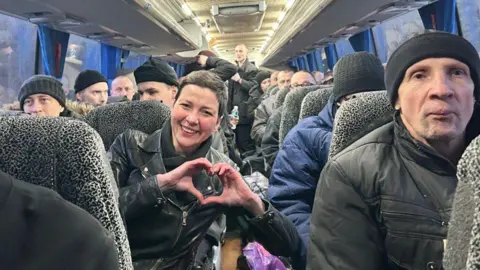
Belarus has freed 123 prisoners, including prominent opposition activist Maria Kolesnikova, after the US agreed to lift sanctions on the country.
Nobel Peace Prize winner Ales Bialiatski is also among those who have been released following talks in Minsk with US President Donald Trump's special envoy for Belarus, John Coale.
The US has agreed to lift sanctions on potash, a key ingredient in fertiliser and an important export for Belarus, which is a close ally of Russia.
Coale said: "As relations between the two countries normalise, more and more sanctions will be lifted."
Belarusian leader Alexander Lukashenko is not recognised as president by the EU.
Kolesnikova has been in prison since 2020, much of the time in isolation. Speaking after her release, she described "a feeling of unbelievable happiness" at being able to see and hug people "dear to me".
She said: "It's a huge happiness to see the first sunset of my freedom, such amazing beauty.
"But also we think of those who are not yet free. I wait for the moment when we can all hug each other, when all are free."
Kolesnikova was handed over to Ukraine along with 113 other prisoners, according to Kyiv's Coordination Headquarters for the Treatment of Prisoners of War.
In a statement on Telegram, Ukraine said that after receiving the necessary medical assistance, the prisoners will be transported to Poland and Lithuania.
 Reuters
Nobel Peace Prize winner Ales Bialiatski arrives in Vilnius
Svetlana Tikhanovskaya, the exiled Belarusian opposition leader who was waiting outside the US embassy in Vilnius, told the BBC the decision to send them to Ukraine was unexpected and had been made by Lukashenko.
A small number, including Bialiatski, were transported to the Lithuanian capital.
After embracing Tikhanovskaya, Bialiatski said: "Thousands of people have been and continue to be imprisoned...so our struggle continues."
Tatsiana Khomich, Kolesnikova's sister, said the first thing Kolesnikova said when they spoke was "thank you to the US administration, President Trump [and] to the Belarus government as well for leading and talking and having these negotiations".
The deal is a major achievement for Lukashenko. The authoritarian leader will also welcome how the Americans have ended his international isolation.
As well as the EU, the US did not recognise Lukashenko as president following unfair elections five years ago which led to mass street protests that were brutally suppressed by police.
Hundreds of people were arrested then - including Kolesnikova - and the intense political repression has continued.

You must be logged in to post a comment.