


2025.09.08 11:08 (Updated 2025.09.08) | Wang Jiemin
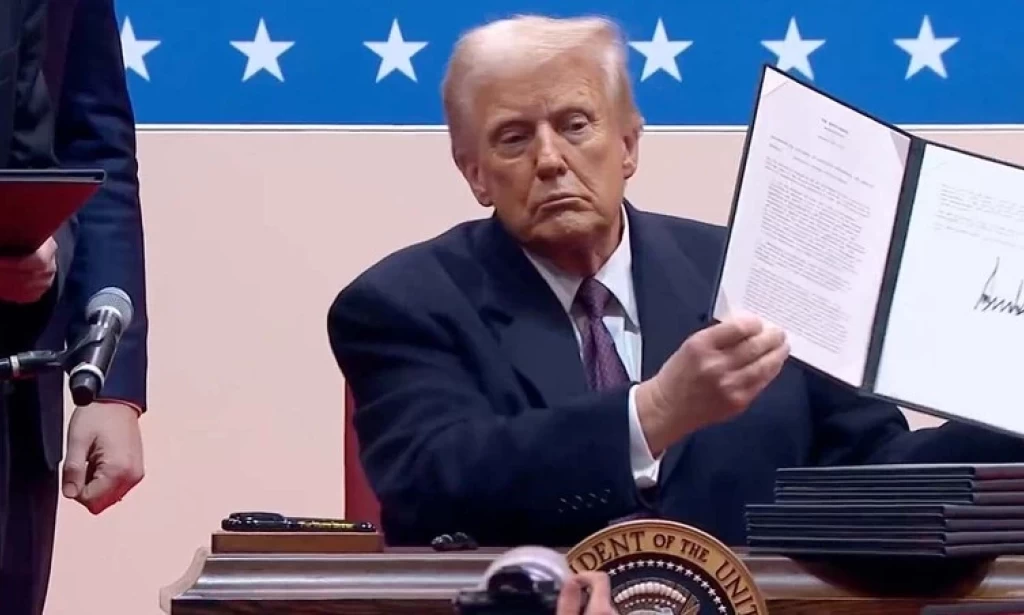
US President Donald Trump. (Photo: X.com/DonaldTrump)
By pressing the stop button, will the US Supreme Court render Trump's tariff efforts futile?
The U.S. jobs report for August showed that nonfarm payrolls increased by a mere 22,000, far below the 75,000 expected by Dow Jones economists, shocking the market.
Meanwhile, the unemployment rate rose to 4.3%, not only a new high since the end of 2021, but also marking the fourth consecutive month of decline in the manufacturing workforce. The June non-farm payrolls figure was revised downwards, showing the first negative employment growth since the pandemic, further exacerbating the situation, as Trump believes that raising tariffs on imported goods equals increased manufacturing jobs.
Faced with such grim employment data, Trump immediately blamed the Federal Reserve for not cutting interest rates in time, but economists were unconvinced. Olu Sonola, chief U.S. economist at Fitch Ratings, bluntly stated, "The labor market sounded alarm bells a month ago, and now the bells are ringing louder. The weaker-than-expected jobs report almost certainly means a 25 basis point rate cut later this month." The fourth consecutive month of decline in manufacturing jobs is particularly noteworthy, and Trump's attempt to deny that "tariff uncertainty" was the main cause of the "weakness" is completely untenable.
Whether tariffs are poison or a bitter pill for the US economy, and whether such a major shift is a blessing or a curse for the world's move towards a bipolar world, is beyond question. Trump will undoubtedly implement his plan, but the variable lies with the US Supreme Court...
Will the US Supreme Court justices support this? We hold our breath.
Excluding the semiconductor and technology industries, U.S. businesses are suffering from the impact of tariffs. As of the end of August, a survey found that more than 60% of small and medium-sized enterprises in the United States were affected by tariffs and had begun to lay off employees or cause a decline in both job supply and demand. This is already reflected in the very poor August non-farm payroll data that was just released!
In response to corporate appeals that Trump violated Congress's direct tariffs, the court formally ruled in late August that Trump's reciprocal tariffs imposed on countries around the world, as well as the fentanyl tariffs imposed on Canada, Mexico, and China, were "all illegal"!
Faced with a rapidly deteriorating economy and litigation, President Trump decided to seek the support of the U.S. Supreme Court. However, in a subsequent conversation at the White House, he frankly and without reservation admitted that if the Supreme Court lost the case, all trade agreements reached with other countries could become invalid.
All invalid? The Big and Beautiful Act may collapse.
It is foreseeable that the "Big America" bill spearheaded by Trump will face scrutiny and stall due to a lack of tariff resources. This would mean that US infrastructure development, income tax cuts, efforts to force unemployed workers to seek employment, reduced social welfare spending, efforts to curb high healthcare costs, and even lower oil prices and increase natural gas production would all be rendered meaningless. Needless to say, the trillions of dollars in trade agreements with Europe, $550 billion with Japan, and $350 billion with South Korea, secured through tariff negotiations, could all vanish. It could even lead to the withdrawal of Apple's promised $600 billion investment, TSMC's $160 billion, and the high-end process technologies from Samsung, LG, and SK Hynix. Most alarmingly, the economy would also suffer setbacks. The Republican Party would certainly be hit hard in the 2026 midterm elections, with Trump suffering a direct blow.
In an effort to persuade the U.S. Supreme Court justices to avert the aforementioned massive disaster, the White House hosted an unprecedented meeting on the evening of the 4th with the world's wealthiest tech entrepreneurs. They pledged over $1.7 trillion in investment commitments. Adding this to the $2.6 trillion in investment commitments from other countries, the total would amount to at least $4.3 trillion in economic stimulus, undoubtedly bringing about a profound and transformative change in the United States.
Therefore, Trump must prove that he can make America strong again, and this new global economic restructuring of human civilization could be reversed as early as November. At that time, world trade will either be on Trump's right track or off track. China and the whole world are anxiously waiting!

You must be logged in to post a comment.