


In 2025, small-dollar day traders and other everyday investors played a bigger role in more markets than ever before. They traded options, sent a new class of meme stocks to the moon and piled into the Magnificent Seven tech companies when the “smart money” got skittish. And they made their presence known just about everywhere else, from precious metals and sporting-event prediction contracts to public stock offerings and late-stage startup investments.
The last time individual investors played such a starring role in the markets was during the meme stock craze of 2021, when an army of amateur traders catapulted shares of companies such as GameStop and AMC Entertainment Holdings, roiling the investment world.
This year’s cohort have shown a more aggressive and sophisticated approach, and are more demanding in what they want from Wall Street, analysts and executives said. And many predict the retail crowd isn’t leaving any time soon.
“They are now a price-setter—a dominant force in the market,” said Scott Rubner, head of equity and equity derivatives strategy at Citadel Securities. “It’s not a passing trend.”
Individual investors have poured a record amount of money into stocks and exchange-traded funds in 2025, according to analysts at JPMorgan Chase, topping levels seen during the meme-stock mania four years ago. The buying spree wasn’t limited to equities: retail investors’ share of option trading volumes is also near records, and they funneled more dollars into the leading gold ETF than in the past five years combined.


The billions that these traders plowed into the markets this year helped power the S&P 500 through every selloff and toward a 16% gain in 2025, the index’s third back-to-back year of double-digit gains.
The growing influence of everyday investors has also come with more risk. Some advocates and industry executives have expressed concern that young traders have been encouraged to seek out quick hits and rapid gains at the expense of sustainable habits.
But for decades, individuals traded in the shadows of a professional class of banks, money managers and deep-pocketed institutions. Those firms had access to cutting-edge technology, reams of research on just about every investible asset, and a devoted brokerage industry that fought aggressively for their business.
Armed with those resources, the “smart money” often seemed to know when to buy or sell. Without those tools or billions to manage, retail investors, derided by Wall Street as the “dumb money,” had to rely more on gut instinct and emotion. And their trades were rarely big enough to leave much more than a ripple in the market. Or so the story went.
That picture has changed markedly in recent years. A generation of new investors have gravitated toward slick brokerage apps that make it easy and inexpensive to trade stocks, options and cryptocurrencies. Individuals now have access to many of the high-risk, high reward assets once reserved for the institutional crowd.
Now, retail trades make up a growing slice of the overall market. They accounted for 22% of industry trading volume in October, according to data from Citadel Securities, the highest level since February 2021.
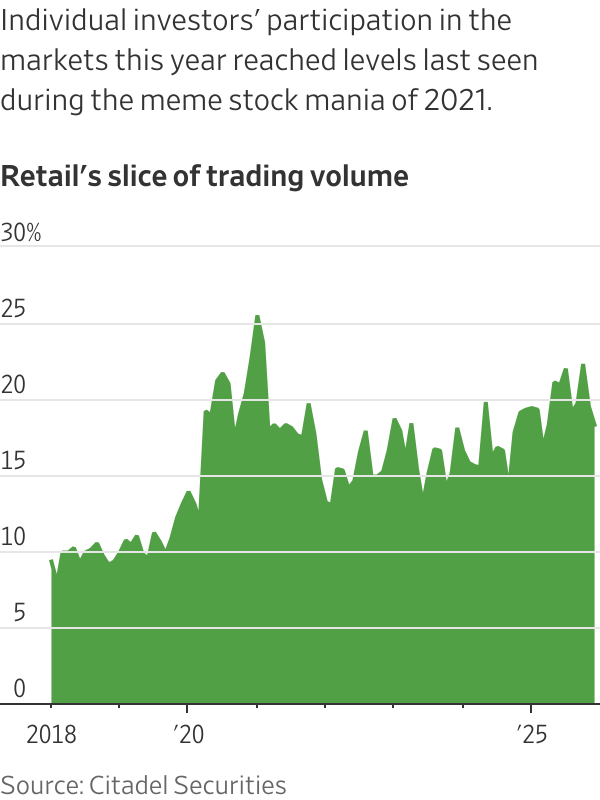
The first signs of retail’s emergence came in the wake of the pandemic. But now, their heightened status is looking more permanent than some professional investors once believed it could be. And it might even survive a major selloff, they said.
“The thesis was that during the pandemic all these people would get involved and then leave,” said Tom Bruni, head of markets and retail investor insights at the social platform StockTwits. “Instead, we’ve seen them stick around…and they’ve matured a lot.”
That movement has been powered by three straight years of double-digit gains for stocks. The S&P rose 16% in 2025. Many traders have reaped even larger gains, thanks to the rapid climb of retail favorites such as Palantir, up 135% this year, or Robinhood Markets, up 204%.
Troy Muckle, a 29-year-old investor based in Hartford, Conn., said his portfolio has just about kept pace with the broader market this year. But he has gotten lucky a couple of times, he said, like when he snapped up shares of shipbuilder Huntington Ingalls Industries in June. The stock is up more than 50% since then.
Muckle is primarily invested in index funds but regularly buys the dip in individual stocks, he said, sometimes waiting to see negative headlines about a company or sector before swooping in.
“I guess you could say I buy bad news a lot,” Muckle said. “Since I’m so young, I’m completely OK with the risk tolerance for large market swings.”
Individual investors’ impulse to pile into stocks when prices slide played a major role in the market’s rapid recovery from April’s tariff turmoil, when President Trump unveiled an aggressive plan for reciprocal tariffs that sent equities tumbling. Retail traders plowed a record net $40 billion into stocks that month, JP Morgan Chase analysts reported, helping to kick-start the rebound.
That mirrored a similar response after the COVID-19 outbreak in March 2020—another moment in which individual investors stepped in to buy the dip.
“You could argue this is the second time that retail has bailed out the market,” said Steve Quirk, chief brokerage officer at Robinhood. “When there’s a crisis, it’s retail [investors] to the rescue—which is the polar opposite of what it used to be.”
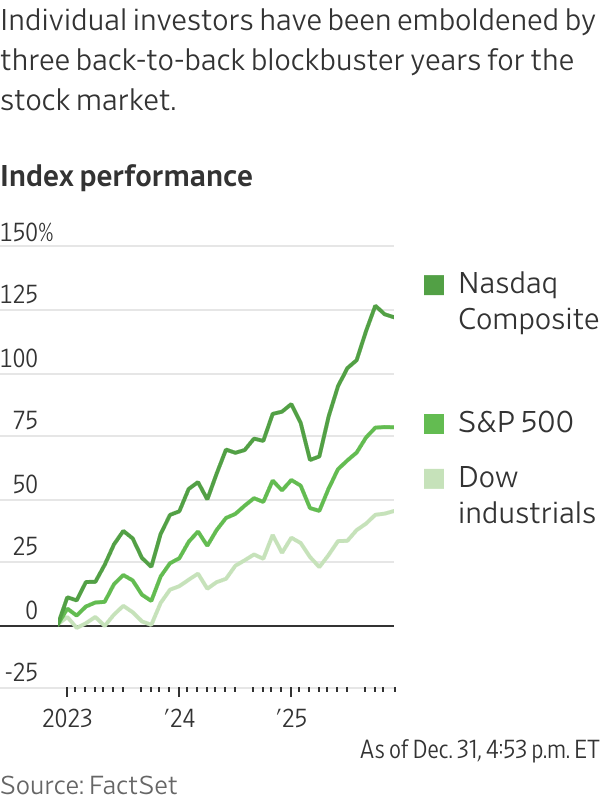
Individual investors have also thrown their weight behind the artificial-intelligence trade, reaping the benefits as big-tech stocks recovered from selloffs time and time again.
When Nvidia stock skidded as much as 14% in April, 34-year-old Andrew Tey bought about $5,000 worth of the company’s shares. That paid off when the chipmaker’s share price doubled from its tariff-turmoil lows over the next several months, eventually making it the market’s first $5 trillion company.
The Santa Monica, Calif.-based electrical engineer said he thinks everyday investors have some advantages over Wall Street pros when it comes to riding out big swings in the market.
“We’re not held to quarterly targets,” Tey said. “I don’t feel any pressure to sell.”
This was also the year that individual investors brought back meme stocks. Traders sent shares of companies Opendoor Technologies, Kohl’s and Beyond Meat skyrocketing during the summer and fall, though much of the gains proved temporary. But in some cases, the mania led to lasting change: individual traders successfully ousted the CEO of Opendoor in August.
But investors aren’t just wagering on single stocks or rushing into ETFs. They are commanding greater influence in IPOs, with companies that went public this year setting aside more shares for everyday buyers. Brokerages also rushed to offer opportunities to invest in private companies, for which more traders have been clamoring.
Sports-betting went mainstream, as trading volumes on prediction-market exchanges such as Kalshi exploded. Even precious metals were in the spotlight, with gold and silver funds among the most-talked-about tickers.
Economists and financial commentators have long noted that the stock market isn’t the economy—or rather, that the broader economy is insulated from temporary downturns in the markets. But as more Americans tie their net worth to stocks, a selloff could have a further-reaching impact. It might also stall the retail investing movement that has taken shape over the last half-decade.
“I wouldn’t underestimate sensitivities to market performance,” Quirk said. If stocks were to fall for a couple of years straight, for example, “we might see behavioral change there,” he said.
Many analysts expect stocks to continue their climb in 2026, albeit at a more modest pace. That positive outlook, combined with a mostly-stable economy, coming tax changes and the prospect of lower interest rates, has many market experts thinking that the strength of the retail crowd is here to stay.
“It’s going to move at this pace or a little faster,” said James Kostulias, head of trading services at Charles Schwab. “People are becoming more and more comfortable managing their money.”

You must be logged in to post a comment.