



Researchers at the University of Kansas Biodiversity Institute and Natural History Museum have recently discovered an old error involving a poison frog specimen from Peru. The specimen had been incorrectly identified decades ago, even though it was used as a holotype.
A holotype is a single preserved specimen collected in the field and designated as the official reference for a species. Today, scientists sometimes also rely on associated information such as photos or genetic data as part of the holotype.
Their findings were published in the journal Zootaxa.
“When you describe a species, you assign one specimen that bears the name of that species,” said lead author Ana Motta, collection manager of herpetology at the Biodiversity Institute. “If I find something else later that looks like that species, I need to go to the holotype and compare things to know if that new population belongs to that species or is something else. So, the holotype is the specimen that represents the species.”
How the Mistake Happened
In 1999, a researcher came across a published photograph of a brightly colored frog from the Peruvian rainforest near the Ecuador border. He could not determine what species it was, so he formally described the frog using only that one image. The photo showed a specimen that had already been deposited in KU’s herpetology collection. It was cataloged as KU 221832, and he gave it the scientific name Dendrobates duellmani.
“Each specimen gets a catalog number. It’s like a barcode,” Motta said. “All photos, genetic data, calls, whatever we have associated with that specimen, are linked to that catalog number. When the researcher saw the photo, instead of asking for the specimen, they asked for just the catalog number, and they were given the wrong catalog number that belonged to another specimen. So, they associated the wrong specimen with the new species description. The true specimen was real. It just had another catalog number.”
Discovering the Error Years Later
When herpetologists recently performing research at the Biodiversity Institute requested to examine the holotype, the error was discovered.
“We had visitors — experts in this frog group — studying many species,” Motta said. “Because the holotype represents the species, they wanted to look at the holotype to understand other populations. When they got the specimen with the described number, they realized: This is not it. The frog is very colorful, and the numbered one was brown.”
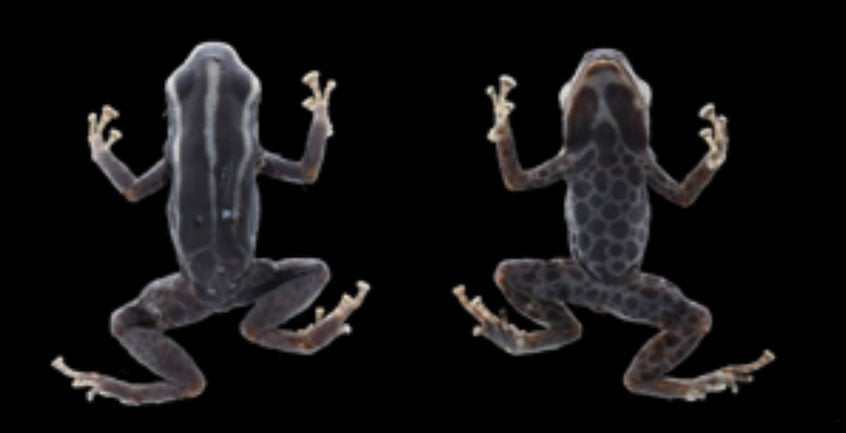 Holotype specimen of Dendrobates duellmani deposited in the KU Herpetology Collection.
Credit: W. E. Duellman
Soon, Motta and her colleagues were engaged in a hunt for clues about how the error occurred in the first place.
“We went through field notes and photo records,” Motta said. “We started matching all kinds of data — what photo belonged to what specimen. We found the correct specimen that was pictured in the photo and made the correction based on that.”
Reclassifying the Frog
In the end, the frog in question has since been reclassified, and it’s no longer deemed to be an independent species. Today, Dendrobates duellmani rather is classified as an example of the Amazon poison frog, Ranitomeya ventrimaculata.
“With more data, we are describing more species — hidden biodiversity that looks alike but is genetically different,” Motta said. “But the opposite happens, too: Things that look different morphologically can be the same species genetically. That’s what happened here. The populations have different colorations but are not reproductively isolated. They share a lot of genetics. They are one species, just with variation. You have extremes, and when you keep collecting, you find a spectrum.”
Motta said the detective work shows the importance of natural history collections and calls for a reexamination of what constitutes a holotype. Because species are going extinct more rapidly than scientists can describe them, she said, there’s pressure to describe species sometimes using less-than-complete information.
“We’re in a new era of collections,” Motta said. “Before, you’d think about a holotype as just the physical object — the animal itself. Now we have the ‘extended specimen.’ All the data and parts associated with that specimen are part of the specimen. The holotype includes the genomic data if that’s available. For example, when you describe frogs, you can use calls. Frogs have species-specific calls. All that belongs to the holotype. It’s part of the holotype.”
Limits of Photo-Based Descriptions
However, the KU researcher said basing a holotype on a photo alone isn’t an optimal approach.
“It’s important to actually work with the specimen itself because specimens are the way that you can confirm things. That research can be reproducible,” Motta said. “The problem occurred because the description was based on a photo. That’s not the best practice. There are discussions on that: Should we be able to describe species based on photos? Having the specimen is the only way you can reproduce or verify data. Data must be verifiable and reproducible. A photo is limited.”
Motta said sorting out the frog confusion, which had been carried forward for over two decades as the error had been cited and reproduced in follow-up research, was a fulfilling moment in her career running a natural history collection, especially as the herpetology division she oversees is the world’s fourth-biggest.
“This is what got me interested in being a collections manager,” she said. “It’s very satisfying, a puzzle. Collections are dynamic and full of new discoveries. There is still so much to understand.”
Reference: “Correction of the holotype and type locality of Dendrobates duellmani Schulte, 1999 (Anura: Dendrobatidae)” by Ana Motta, Leandro J.C.L. Moraes, Annette Weldon, Lauren Mckinley and Jason L. Brown, 16 September 2025, Zootaxa.

You must be logged in to post a comment.