


When it comes to sculpting a balanced, powerful physique, back training is non-negotiable—and it’s deeply intertwined with core strength. Your back isn’t just a “show” muscle; it’s the foundation of core stability, supporting every upper-body movement from lifting weights to reaching for a shelf. A strong back improves posture, reduces lower back pain, enhances athletic performance, and creates the coveted V-taper that makes your waist appear slimmer and shoulders broader. Yet with endless back exercises circulating online—pull-ups, rows, lat pulldowns, deadlifts—it’s tough to separate effective moves from inefficient ones. That’s why we’ve created this ultimate ranking of back exercises, designed to cut through the noise and focus on science-backed moves that deliver real results. Whether you’re a beginner building foundational strength or an advanced lifter refining your back development, this guide will help you prioritize exercises that maximize muscle growth and core stability.
Ranking Criteria: How We Selected the Best Back Exercises
Your back is a complex network of muscles—latissimus dorsi (lats), trapezius (traps), rhomboids, erector spinae, and teres major/minor—all working in tandem with your core. To ensure our ranking is credible and actionable, we evaluated each exercise against six key, science-driven criteria:
• EMG Data: We relied on electromyography (EMG) studies to measure muscle activation. Higher EMG readings indicate more muscle fibers are engaged, directly correlating to better strength gains and hypertrophy (muscle growth).
• Strength & Size Building: Exercises that build both raw strength (ability to lift heavy) and muscle size ranked higher, as they offer dual benefits for overall back development.
• Versatility: The best back exercises adapt to all fitness levels—beginners can modify them to build confidence, while advanced lifters can add intensity to keep challenging their muscles.
• Functionality: Moves that translate to real-life strength (e.g., lifting groceries, maintaining posture at work) or athletic performance (e.g., pulling, rowing) scored higher than isolated, non-functional exercises.
• Low Injury Risk: We prioritized exercises that minimize strain on the lower back and shoulders when performed with proper form, as back injuries are common and can derail long-term progress.
• Hormone Impact: Compound back exercises (which engage multiple muscle groups) boost testosterone and growth hormone production—key hormones for full-body muscle growth—giving them an edge over isolation moves.
Top 8 Back Exercises: Ranked from Most to Least Effective
After rigorous evaluation, these 8 exercises emerged as the best for building a strong, thick back while supporting core stability. Each targets different areas of the back (width, thickness, upper back, lower back), so combining them ensures balanced development.
No.1: Pull-Ups/Chin-Ups – The King of Back Width & Core Stability
Pull-ups (palms away) and chin-ups (palms toward) take the top spot—they’re the gold standard for building wide lats and activating your core. EMG studies consistently show pull-ups engage the lats more than any other back exercise, while also recruiting the traps, rhomboids, biceps, and entire core to stabilize your body. This compound movement builds both back width and functional core strength.
How to do it: Grip the pull-up bar with your chosen grip (shoulder-width for standard pull-ups). Hang with arms fully extended, core braced, and feet crossed. Pull your chest up toward the bar by squeezing your lats, then lower slowly (2-3 seconds) back to the start. Aim for 3-4 sets of 6-12 reps.
Modifications & Progressions: Beginners can use resistance bands (loop around the bar and place a knee in it) or an assisted pull-up machine. Advanced lifters can add weight (via a belt), try wide-grip pull-ups (for lats focus), or commando pull-ups (palms facing each other, for balanced back/bicep activation).
No.2: Bent-Over Barbell Rows – The Queen of Back Thickness
If pull-ups build width, bent-over barbell rows build thickness—making them essential for a 3D back. This compound move targets the mid-back (rhomboids, traps, mid-lats) and lower back, while your core works overtime to stabilize your torso. It’s a staple for building raw back strength and mass, and EMG data confirms it’s one of the most effective mid-back exercises.
How to do it: Hold a barbell with an overhand grip (shoulder-width). Hinge at the hips until your torso is 45 degrees to the floor, knees slightly bent. Keep your back flat, core braced, and chest up. Pull the bar toward your lower chest by squeezing your shoulder blades together, then lower slowly. Do 3-4 sets of 8-10 reps.
Key Form Tip: Keep the bar close to your legs to minimize lower back strain and maximize mid-back activation. Avoid pulling with your arms—focus on driving the movement with your back muscles.
No.3: Deadlifts – Full-Back & Core Powerhouse
Deadlifts are often labeled a leg exercise, but they’re a full-body movement that dominates back and core activation. They target the entire posterior chain—lower back (erector spinae), traps, lats, glutes, and hamstrings—while your core braces to protect your spine. Deadlifts build raw strength that carries over to every other back exercise, and their hormone-boosting benefits accelerate full-body muscle growth.
How to do it: Stand with feet shoulder-width apart, barbell over the middle of your feet. Hinge at the hips, bend knees, and grip the bar (overhand or mixed grip for stability). Keep your back flat, chest up, and core braced. Lift the bar by driving through your heels, keeping it close to your legs, until you’re upright. Lower slowly. Do 3-4 sets of 4-6 reps (strength-focused).
Safety Note: Master form with a trainer before adding weight—rounding your back can cause serious injury. Keep your core tight throughout the movement to protect your spine.
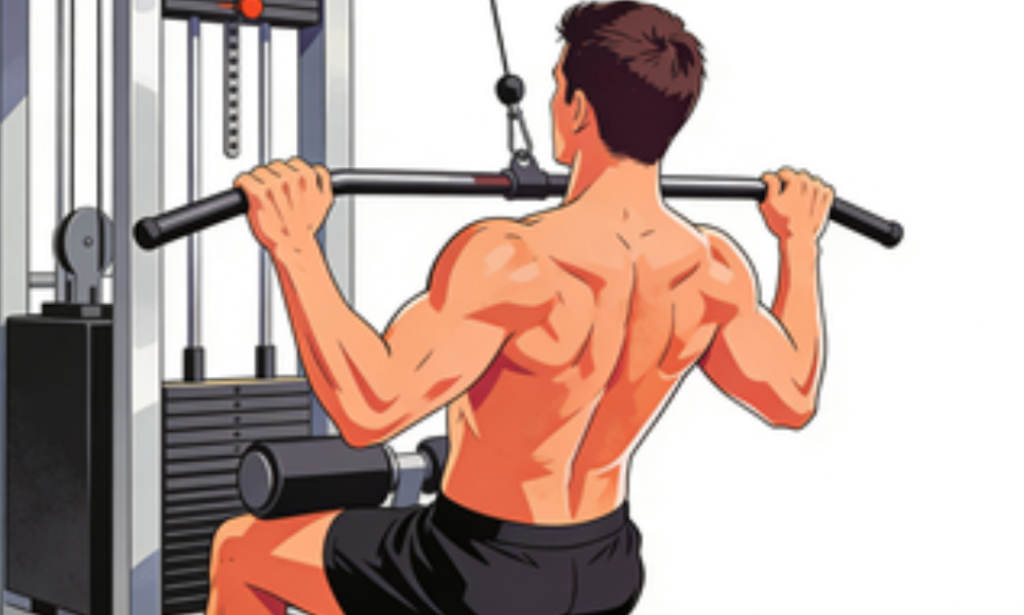
No.4: Lat Pulldowns – Best Pull-Up Alternative
Lat pulldowns are the perfect alternative for anyone who can’t yet do full pull-ups, or for lifters looking to target lats with more control. They mimic pull-up mechanics but allow weight adjustments, making them ideal for all levels. EMG data shows lat pulldowns activate lats nearly as effectively as pull-ups when done with proper form.
How to do it: Sit at a lat pulldown machine, grip the bar with a wide overhand grip (wider than shoulder-width). Keep chest up, core braced, and feet flat. Pull the bar down to your upper chest by squeezing your lats, then let it rise slowly (don’t fully extend arms—keep tension on lats). Do 3-4 sets of 8-12 reps.
Common Mistake: Avoid swinging the bar or pulling with momentum—this reduces lat activation and strains shoulders. Focus on slow, controlled movements.
No.5: Face Pulls – Upper Back & Shoulder Stability
Face pulls are often overlooked, but they’re critical for balancing back training and protecting shoulders. They target the rear delts (posterior shoulders), upper traps, and rhomboids—muscles that counteract rounded shoulders (a common desk-related issue) and support core stability. EMG studies show face pulls are one of the best exercises for upper back activation.
How to do it: Attach a rope to a cable machine at eye level. Grip the rope with palms facing each other, step back 2-3 feet, and brace your core. Pull the rope toward your forehead by squeezing your shoulder blades together, then slowly release. Do 3-4 sets of 12-15 reps (higher reps for endurance).
Why It Matters: Weak upper back muscles lead to poor posture, shoulder pain, and reduced performance in other back exercises. Add face pulls to every back workout for balanced development.
No.6: T-Bar Rows – Thick Mid-Back & Traps
T-bar rows are a favorite among bodybuilders for building dense mid-back mass. They use a T-bar setup (machine or barbell + landmine attachment) for stability, allowing you to lift heavier weights than traditional rows while reducing lower back strain. EMG data confirms they’re highly effective for activating rhomboids and mid-lats.
How to do it: Stand at a T-bar row machine, grip the handles. Hinge at the hips until your torso is parallel to the floor, knees slightly bent. Keep your back flat, core braced. Pull the handles toward your lower chest by squeezing your shoulder blades, then lower slowly. Do 3-4 sets of 8-10 reps.
No.7: Seated Cable Rows – Controlled Mid-Back Activation
Seated cable rows are ideal for targeting the mid-back with constant tension, thanks to the cable’s smooth resistance. The machine supports your torso, so you can focus purely on contracting your back muscles (no core strain from balancing). They’re great for correcting muscle imbalances and building defined mid-back muscles.
How to do it: Sit at a seated cable row machine, place feet on the footrests, and grip the handle (V-bar or straight bar). Keep chest up, core braced, and back straight. Pull the handle toward your lower chest, squeeze your shoulder blades, then slowly extend your arms. Do 3-4 sets of 10-12 reps.
Variation: Use single-arm cable rows to target each side of your back individually—perfect for fixing imbalances.
No.8: Superman Exercises – Lower Back & Core Stability
Supermans are an isolation exercise that targets the lower back (erector spinae) and core—critical for supporting heavy back lifts (like deadlifts) and improving posture. They’re low-impact, easy to do, and require no equipment, making them ideal for beginners or as a finisher.
How to do it: Lie face down on the floor, arms extended overhead, legs straight. Simultaneously lift your arms, chest, and legs off the floor (like Superman flying), hold for 1-2 seconds, then lower slowly. Do 3-4 sets of 15-20 reps.
Modification: If full supermans are too hard, lift just your arms/chest or just your legs—focus on contracting your lower back muscles throughout.
Sample Weekly Back Routine (2x/Week, Progressive Overload Focus)
To build a strong, balanced back, train it 2x per week (with 48 hours of rest between sessions) to allow muscle recovery. Focus on a mix of compound (width/thickness) and accessory (upper/lower back) exercises, and apply progressive overload (gradually increase weight/reps) to keep challenging your muscles. Here’s a science-backed routine:
• Workout 1 (Width & Core Stability): 1. Pull-Ups (3x8-10), 2. Lat Pulldowns (3x10-12), 3. Bent-Over Barbell Rows (3x8-10), 4. Face Pulls (3x12-15), 5. Superman Exercises (3x15-20)
• Workout 2 (Thickness & Strength): 1. Deadlifts (3x4-6), 2. T-Bar Rows (3x8-10), 3. Seated Cable Rows (3x10-12), 4. Single-Arm Dumbbell Rows (3x10-12 per arm), 5. Face Pulls (3x12-15)
Example of progressive overload: If you can do 10 pull-ups easily, add a 5kg dumbbell to a belt next time. If you lift 50kg for 8 reps in bent-over rows, try 55kg for 6 reps. Small, consistent increases drive long-term growth.
Common Back Training Mistakes to Avoid
Even with the best exercises, bad form can hinder progress and cause injury. Here are the most common back training mistakes:
• Rounding Your Back: The biggest culprit of back injuries. Rounding your spine during rows or deadlifts reduces muscle activation and strains the lower back. Always keep your back flat and core braced.
• Pulling with Your Arms: Back exercises are about contracting your back muscles, not your biceps. Focus on squeezing your shoulder blades together when pulling—let your back do the work.
• Neglecting Upper Back: Fixating on lats (width) ignores the upper back, leading to poor posture and shoulder pain. Add face pulls to every workout.
• Not Warming Up: Your back is complex—warm up with 5-10 minutes of light cardio (jogging, rowing) and dynamic stretches (arm circles, cat-cow) before lifting heavy. This increases blood flow and reduces injury risk.
• Overtraining: Training your back more than 2x per week leads to overtraining (persistent soreness, fatigue, reduced performance). Give your back 48 hours to recover between sessions.
Conclusion: Consistency, Form & Diet for a Strong Back
Building a strong, thick back takes time—don’t expect results in a week or two. The exercises in this ranking are proven to work, but only if you prioritize consistency, proper form, and progressive overload. Remember: your back and core are inseparable—strong back muscles support core stability, and a strong core enhances back training performance.
Nutrition also plays a key role: eat in a slight caloric surplus (250-500 calories above TDEE) if building mass, or maintain your calories if focusing on strength. Consume 1.6-2.2g of protein per kg of body weight daily to support muscle repair and growth (chicken, fish, eggs, Greek yogurt, protein powder are great sources).
If you’re a beginner, start with modified exercises (assisted pull-ups, dumbbell rows) and master form before adding weight. Advanced lifters can challenge themselves with weighted variations or drop sets to keep training intense.
What’s your biggest back training challenge? Do you struggle with any of the moves in this ranking? Let me know in the comments below—I’d love to help you improve!

You must be logged in to post a comment.