



Ms. Wu broke down in tears at the hospital after a routine physical exam revealed she had thyroid cancer—her reaction is one shared by countless people who hear the word “cancer”. But her doctor was quick to comfort her: thyroid cancer is highly treatable, with an exceptionally high 20-year survival rate, and there was little cause for extreme worry.
Cancer has long been a word that strikes fear into hearts, and for good reason. In the past, limited medical screening methods meant cancer was often detected only in its advanced or metastatic stages, when survival rates were devastatingly low. Compounded by the painful complications that come with late-stage cancer, it’s no wonder the disease is so feared. In a casual conversation with colleagues about the illness people dread the most, nearly everyone named cancer—the second leading cause of death—while cardiovascular disease, the number one killer, was barely mentioned. The common thread? A crippling fear of cancer’s debilitating complications.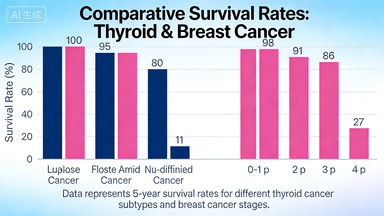
But a lingering question remains: Does a cancer diagnosis, or its subsequent complications, mean a certain death sentence?
The answer is far from simple, and the better question to ask is: What is the likelihood of passing away within a specific timeframe? For cancer patients, medical professionals use the 5-year survival rate as the key metric to evaluate treatment success. Defined as the percentage of patients who live for more than 5 years after diagnosis and treatment, a higher 5-year survival rate indicates a cancer that is more manageable and controllable.
The core of cancer’s terror lies in its unpredictability: it is prone to recurrence and metastasis, even after successful surgery. A handful of remaining cancer cells can lie dormant, then rapidly multiply and spread when the body is weak or the immune system is compromised. Clinically, however, a critical pattern has emerged: if cancer does not recur or metastasize within 5 years of treatment, the risk of it doing so later drops to nearly zero. In such cases, the cancer is generally considered clinically cured.
5-year survival rates vary drastically not only between different cancer types but also for the same cancer, depending on when it is detected.
Take thyroid cancer, often dubbed the “good cancer” for its favorable prognosis, as an example:
Papillary thyroid cancer (the most common type): nearly 100% 5-year survival rate
Follicular thyroid cancer: approximately 95% 5-year survival rate
Medullary thyroid cancer: around 80% 5-year survival rate
Anaplastic thyroid cancer (the most aggressive): only 11% 5-year survival rate
Breast cancer shows a similar stark contrast based on staging at diagnosis:
Stage 0-1: ~98% 5-year survival rate, with an 87% 10-year survival rate
Stage 2: ~91% 5-year survival rate, with a 62% 10-year survival rate
Stage 3: ~86% 5-year survival rate, with a 46% 10-year survival rate
Stage 4: ~27% 5-year survival rate, with a 20% 10-year survival rate
In short, there is no one-size-fits-all answer to “How long can someone live after a cancer diagnosis?”. The outcome hinges on a multitude of factors: the type of cancer, whether it is detected in the early or late stage, the patient’s overall physical health, and the effectiveness of treatment. No definitive conclusions should be drawn without professional medical guidance.
If you or a loved one receives a cancer diagnosis, the best course of action is to consult a specialist—they can provide a personalized prognosis based on your unique situation, and outline the most effective treatment plans to maximize survival and quality of life.

You must be logged in to post a comment.