



Many physical discomforts can throw us off our game.
Think about it:
- Phlegm stuck in your throat that you just can’t cough up
- An oncoming sneeze that dies down before it comes out
- Holding in gas that refuses to escape
But compared to these nuisances, there’s one sensation that’s even more frustrating—it goes like this:
A sudden urge to poop hits you, so you rush to the bathroom.You squat there for half an hour, straining every muscle in your body, only to find nothing comes out.Defeated, you head out the door—then the urge strikes again.In the end, you’re left with that annoying feeling of never really finishing your business.
This unpleasant symptom actually has a specific medical term: tenesmus.
The word breaks down into two parts:
- Tenesmus (the "urgency" part): It describes the intense, urgent feeling that you need to empty your bowels right away, as if a bowel movement would bring instant relief.
- The "heaviness" part: It refers to that heavy, dragging sensation in your anus, rectum, and even the base of your spine—like something is stuck and won’t come out, no matter how hard you try.
To sum it up in one sentence: tenesmus is that frustrating feeling of constantly needing to poop but never fully emptying your bowels.
So, what causes this bizarre sensation?
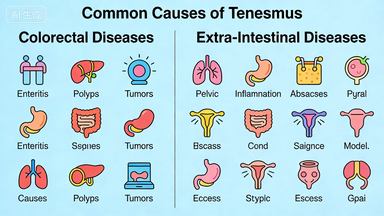 Caption
1. Colorectal Diseases
If you’ve ever had chronic enteritis, you’re probably familiar with that "incomplete evacuation" feeling. People with this condition often have loose stools too.
Chronic enteritis usually develops when acute enteritis lingers or keeps coming back. Long-term overfatigue, mental stress, and malnutrition are all common triggers for the condition.
Beyond chronic enteritis, a range of related colorectal issues can also cause tenesmus, including:
- Chronic ulcerative colitis
- Crohn’s disease
- Chronic bacillary dysentery
- Amebic dysentery
- Colorectal polyps
- Colorectal tumors
2. Extra-Intestinal Diseases
According to relevant medical literature, certain gynecological problems can also lead to pseudo-tenesmus—a false sense of needing to defecate. These issues include:
- Pelvic inflammatory disease
- Pelvic abscess
- Pelvic appendicitis
- Vaginal bleeding caused by various gynecological conditions
The Bottom Line
Tenesmus is not triggered by the presence of stool waiting to be passed. Instead, it’s a false urge to defecate, paired with a feeling of anal heaviness, caused by inflammation irritating the nerves in the intestinal mucosa.
Since there’s actually no stool in the rectum to expel, no matter how long you spend on the toilet straining, you’ll never get that satisfying feeling of a complete bowel movement.

You must be logged in to post a comment.